Brought to you by PrideVMC Diamond Partner Boehringer Ingelheim
0:01 / 5:29 Healing through horses – how animals can help retrieve trust in ourselves
The girl took lessons in tennis, dance and gymnastics. In school, she joined the book club and student council. She dreamed of becoming a psychologist.
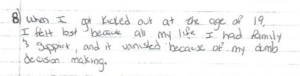
As a teen, though, she dabbled in drugs and started to steal, she said. At 19, after her freshman year in college, she said, her parents kicked her out after she tested positive for an illegal substance. She bounced from place to place and said she eventually endured sexual assault.
“That scared me. It made me angry and physically violent,” she said.
The special bond between animals and people played an important role on a road to recovery for the woman, who answered questions in writing and by phone on the condition that her identity remain confidential. We’ll call her Kristy.
Eventually, Kristy joined other girls and women in metro Atlanta at Wellspring Living, a nonprofit that for more than 20 years has helped survivors of sex trafficking and exploitation. The organization offers clinical therapy, education and instruction in basic life skills. It also has discovered a new way to help: therapeutic horse lessons.
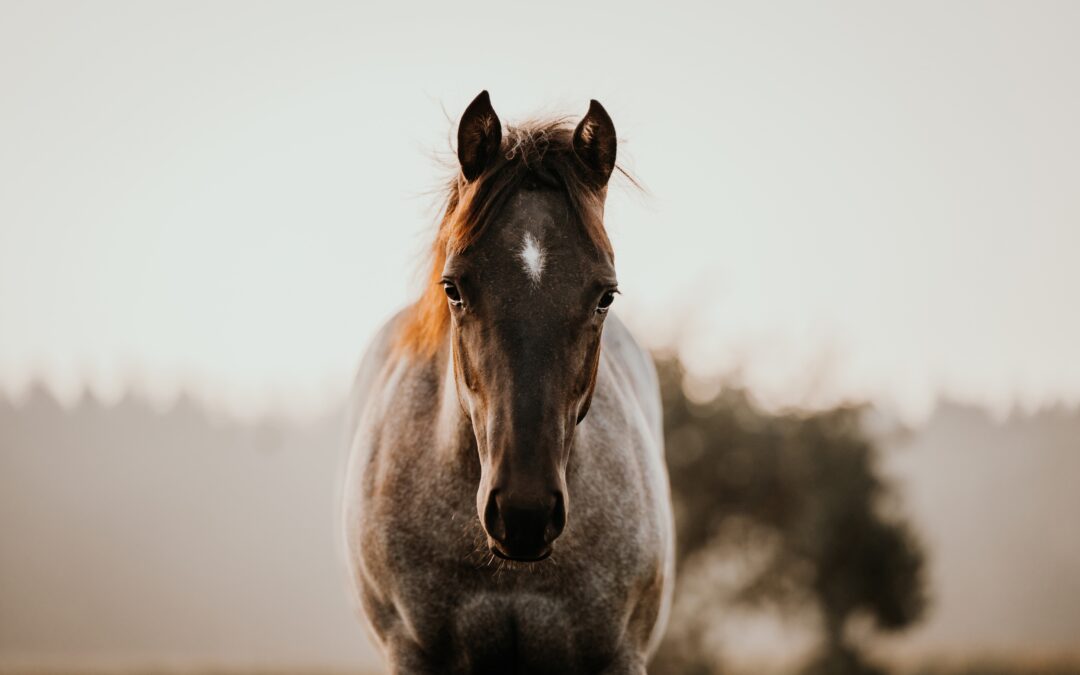
Since 2019, Wellspring Living has taken women to another Atlanta nonprofit, Chastain Horse Park, where instructors help them settle into the saddle. Accustomed to having little control, participants take the reins. They learn to control a horse. They also learn to trust.
“For someone that has been cut down and not given a voice, being able to work with a thousand-pound horse is a huge achievement,” said Kelcy Rainer, therapeutic program director at Chastain Horse Park.
Financial support for the sessions comes from donors that include the Boehringer Ingelheim Cares Foundation. The foundation is the independent U.S. philanthropic arm of Boehringer Ingelheim, which has the U.S. headquarters of its Animal Health business in metro Atlanta.
Thousands of people worldwide benefit from equine-assisted services, from people with post-traumatic stress disorder to those with developmental disabilities or conditions like cerebral palsy. Organizations around the United States also are harnessing the healing power of horses to help survivors of sex trafficking and exploitation.
“Most of the time they’re coming in very guarded. They don’t have a certain level of trust for anyone because of their past experiences,” Rainer said.
Kristy rode a horse named Hank. She was scared at first, she said, but Hank stayed calm, and that helped her relax. Her fear diminished. Her confidence increased.
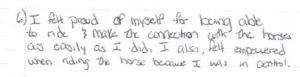
“That was important in helping me learn to trust other people,” she said.
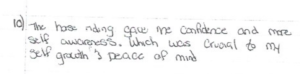
Another woman shared a similar story after participating in therapeutic riding lessons supported by the Boehringer Ingelheim Cares Foundation. She answered questions in writing and also asked not to be identified. We’ll call her Becca.
“I feel like I didn’t really get the chance to be a kid,” she said. “I grew up too fast.”
Becca said she benefitted from her time in the saddle.
“I definitely built a connection with the horse that I rode and felt it while we were riding,” she said. “There was an amount of trust between us.”
Time on horseback taught her that “acceptance and trust … goes both ways,” she said.
“I feel like I have to constantly remind myself how far I’ve come and all I’ve endured and how it’s just constantly molding me into the person I’m becoming,” she said.
“I think that anyone who is willing to take part in therapeutic riding will benefit from it tremendously. Thank you so much for what you are doing and will continue to do for many others.”
Becca recently moved into a tiny home at a Wellspring Living transitional housing community. She plans to go back to school and “continue to plant roots and rebuild my life here in Georgia.”
Kristy also is focused on the future. She works at a clothing store, measuring customers and selling suits. She aspires to study computer science.
That future is possible because of organizations like Wellspring Living and Chastain Horse Park and financial support from donors such as the Boehringer Ingelheim Cares Foundation – but mostly because of the unique bond that connects horses and people.
“A horse doesn’t care what color you are, if you have a stutter, if you don’t speak – you’re non-verbal – if you have an amputation,” Rainer said. “They are going to treat you and any other person, with a disability or without the same exact way.”